
The "Limestone Mask": How Hard Water Minerals are Mimicking Chronic Dryness and Blocking Your Most Expensive Masks
You're doing everything right. You invest in high-quality, salon-grade hair masks, you use leave-in conditioners, and you avoid excessive heat styling. Yet, your hair remains stubbornly dry, brittle, and dull. It feels like no matter how much moisture you pour into it, your hair simply refuses to cooperate, leaving you frustrated and wondering what you're missing. The truth is, the problem might not be with your products or your routine, but with the very water you use to wash your hair every day.
This hidden saboteur is hard water with a high concentration of dissolved minerals like calcium and magnesium. As you rinse your hair, these minerals latch onto the hair shaft, building up over time to form an invisible, armor-like film. We call this the 'limestone mask.' This mineral cast creates a physical barrier that not only makes your hair feel rough and look lackluster but also actively blocks the nourishing ingredients in your expensive treatments from ever reaching the hair fiber. Your conditioner isn't failing; it's being physically stopped at the gate.
This mineral buildup is a master of disguise, perfectly mimicking the symptoms of chronic dryness and damage. It causes tangles, weighs down your style, can distort your natural curl pattern, and even cause your hair color to look brassy or faded. You are essentially conditioning a layer of rock, not your actual hair. To reclaim your hair's potential for softness, shine, and health, you must first address this foundational issue. It's time to stop fighting the symptoms and start treating the cause by breaking down that mineral barrier and letting your hair breathe again.
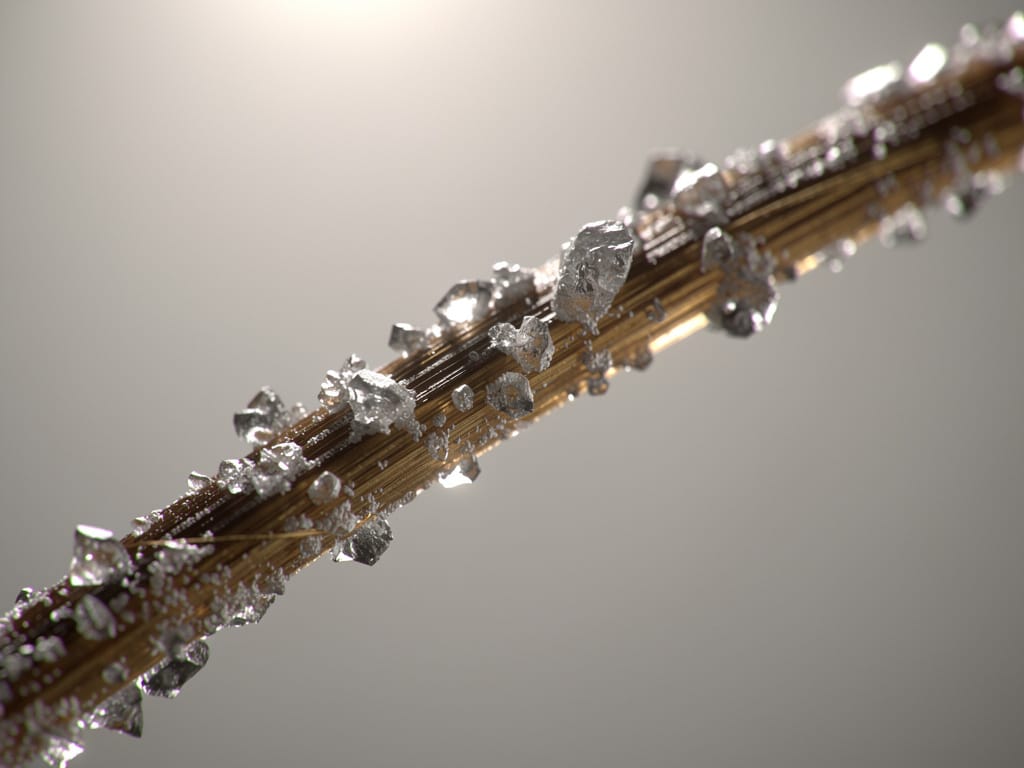
- Hard water contains dissolved minerals, primarily calcium and magnesium, that build up on your hair.
- This accumulation forms a 'limestone mask' that makes hair feel perpetually dry, brittle, and rough.
- The mineral film acts as a barrier, preventing conditioners, masks, and treatments from penetrating the hair shaft.
- Symptoms of mineral buildup include dullness, tangles, color fading, and a lack of responsiveness to products.
Frequently Asked Questions
How can I tell if hard water is my problem?
There are several tell-tale signs that hard water is affecting your hair. Physically, your hair might feel consistently coated, waxy, or straw-like, even right after washing. It may appear dull and lack natural shine, no matter what glossing products you use. If you notice your hair tangles much more easily than it used to, or your expensive hair color turns brassy and fades exceptionally fast, mineral buildup is a likely culprit. Beyond your hair, look for evidence around your home. White, chalky residue-known as limescale-on your faucets, shower doors, and kettle is a clear indicator that you have hard water.
Won't a regular shampoo remove this mineral buildup?
Unfortunately, no. Most standard shampoos are formulated with gentle surfactants designed to remove dirt, oil, and product residue. They are simply not equipped to deal with the stubborn bond that mineral deposits form with the hair fiber. These minerals have a positive charge that is strongly attracted to the negative charge of your hair, making them difficult to dislodge with conventional cleansers. To effectively remove this 'limestone mask,' you need a specialized product with ingredients that can break this bond and pull the minerals away from the hair strand.
What is the most effective way to remove the 'limestone mask'?
The solution is to use a clarifying or chelating shampoo. These are powerful, deep-cleansing formulas that contain specific ingredients called 'chelating agents' (like Disodium EDTA, Sodium Gluconate, or Phytic Acid). These agents act like magnets, binding to the mineral ions and rinsing them away completely. Think of it as a powerful detox that strips away the mineral shell and resets your hair to its natural state. Because they are so effective, these shampoos should be used strategically-perhaps once every one to two weeks-to break down buildup without overly stripping your hair of its natural oils.
Once I've clarified my hair, how do I prevent the buildup from returning?
Removing the buildup is the first step; preventing its return is the key to long-term hair health. The single most impactful action you can take is to install a hard water shower filter. These filters attach directly to your showerhead and work to remove a significant portion of the calcium and magnesium before the water ever touches your hair. This proactive approach stops the problem at the source. In combination with the filter, continuing to use a chelating shampoo every few weeks for maintenance will keep any residual mineral accumulation in check, ensuring your hair remains soft, responsive, and ready to absorb all the benefits of your conditioning treatments.