
Your Hair Type Isn't Real: A New Model
Let's Get One Thing Straight (or Curly, or Coily)
I'm going to say something that might sound like heresy in the beauty world. Ready?
Your hair type isn't real.
There, I said it. That neat little system of numbers and letters-1A, 2C, 4B-is, for the most part, a well-intentioned but deeply flawed marketing tool. It’s like trying to describe a person's entire personality using only their shoe size. It gives you one piece of information, and a fairly superficial one at that.
For years, we've been squeezed into these little boxes. We buy products 'for curly hair' or 'for straight hair', wondering why they don't always work. The reason is simple: curl pattern is only one chapter of your hair's story. And it's probably not even the most important one.
Here's the truth: relying solely on the traditional typing system is a fast track to a cabinet full of half-used, disappointing products.
A Better Way: Your Hair's True Identity
If we're ditching the old model, what replaces it? A more intelligent, holistic framework that looks at the biological properties of your hair. Instead of a single 'type', think of your hair as having a unique profile built on three core pillars.
Understanding these will change everything about how you select products and manage your hair's health. Let's break it down.
Pillar 1: Porosity - The Thirst Factor
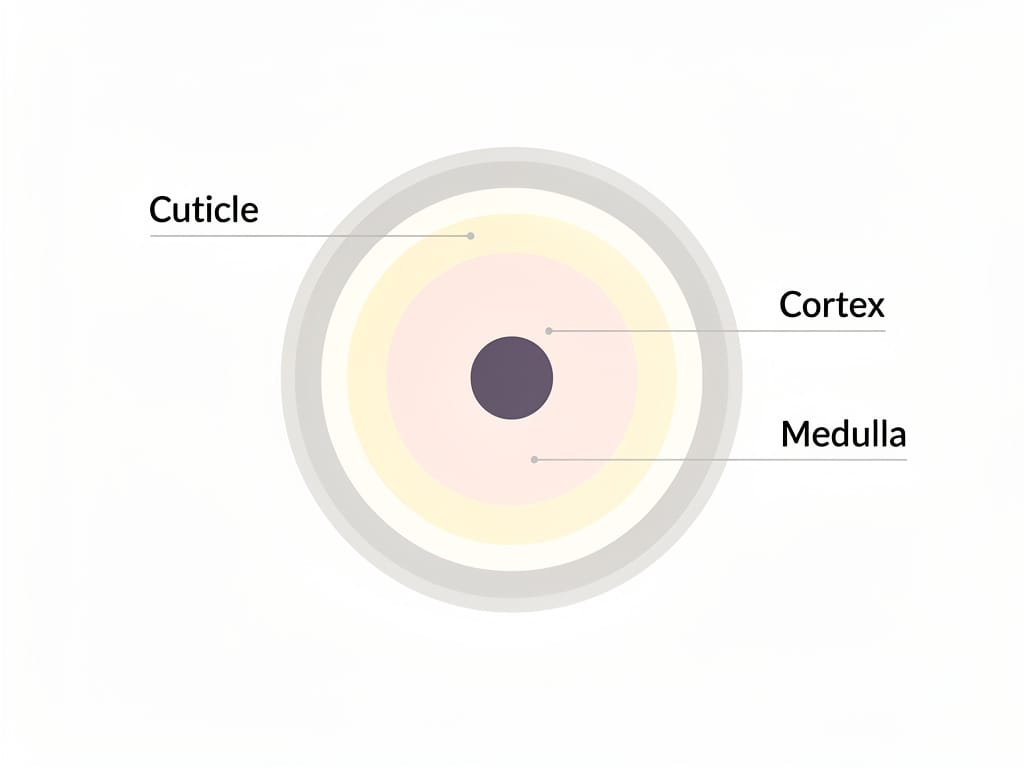
This is the big one. Porosity describes your hair's ability to absorb and hold onto moisture. It's determined by the structure of your hair's cuticle layer-the outer, protective shell.
- Low Porosity: The cuticles are tightly packed and flat. It's difficult for moisture to get in, but once it's in, it stays. This hair is prone to product buildup because things tend to sit on top of it.
- Medium Porosity: The 'just right' of the hair world. The cuticles are looser, allowing moisture to penetrate easily and be retained well.
- High Porosity: The cuticles have gaps and holes, either from genetics or damage (heat, chemical treatments). This hair soaks up moisture like a sponge... and loses it just as quickly.
Why it matters: A product designed for high-porosity hair (which needs proteins and heavy sealants) will feel greasy and heavy on low-porosity hair. Conversely, the lightweight hydrators that low-porosity hair loves will do almost nothing for high-porosity strands.
Pillar 2: Texture - The Individual Strand's Story
Texture, in this context, refers to the thickness or diameter of an individual hair strand. Don't confuse this with how your overall hair feels; you can have 'soft' hair that is texturally coarse.
Grab a single strand of your hair. Can you feel it between your fingertips? If you can't, it's likely fine. If you can feel it, it's medium. If it feels thick and, well, wiry, it's coarse.
Why it matters: Fine hair is delicate and easily weighed down. It needs lightweight products. Coarse hair is strong and more resistant to damage, but it can also be more resistant to hydration and chemical services. It can typically handle richer, heavier products without going limp.
Pillar 3: Density - The Crowd on Your Head
Density is all about how many individual hair strands are packed into a square inch of your scalp. It's the difference between a sparse forest and a thick jungle.
Part your hair and look in the mirror. Can you easily see your scalp? That's likely low density. If you have to work a bit to see your scalp, you're in the medium density camp. If seeing your scalp is a genuine struggle, you've got high density hair.
Why it matters: Low-density hair needs products that create volume and don't weigh it down, making the sparseness more obvious. High-density hair can handle heavier products and often requires more of it to ensure every strand gets some love.
Your New Hair Profile
So, where does curl pattern fit in? It's still part of the picture! It's the fourth variable. But now, it has context.
Let's build a profile. Instead of the vague label 'Type 4A', you might discover you have:
High-porosity, fine-textured, high-density, coily hair.
See the difference? This profile gives you a detailed roadmap. You know you need protein for the high porosity, lightweight products for the fine texture, and enough product to cover your high density, all while choosing stylers that will support your coily pattern.
It's not about finding a label. It's about gathering intelligence.
Stop asking 'What's my hair type?' and start asking 'What is my hair's profile?'. This shift from a rigid box to a dynamic profile is the foundation of mindful hair care. It's about listening to your hair and giving it what it actually needs, not what a chart tells you it should want.